
FOR EMPLOYMENT COUNSEL
The Bushway Opportunity Score™: a resource kit for counsel.
Research, application, and boundaries for attorneys who advise employers on criminal-history review. The materials are free to read and download. No registration is required.
The resource kit
Free to download. No registration. Updated October 2026.
Why this matters
A criminal record describes past events. On its own, it does not show what the passage of time and the pattern of a person’s record indicate about reconviction risk today. Research on desistance shows that this relationship changes over time, and that age and time since the most recent conviction are central to it.
The Bushway Opportunity Score translates selected facts of a record into a standardized, research-based measure. It is designed to supplement individualized review, never to replace it.
The score at a glance
- What it estimates
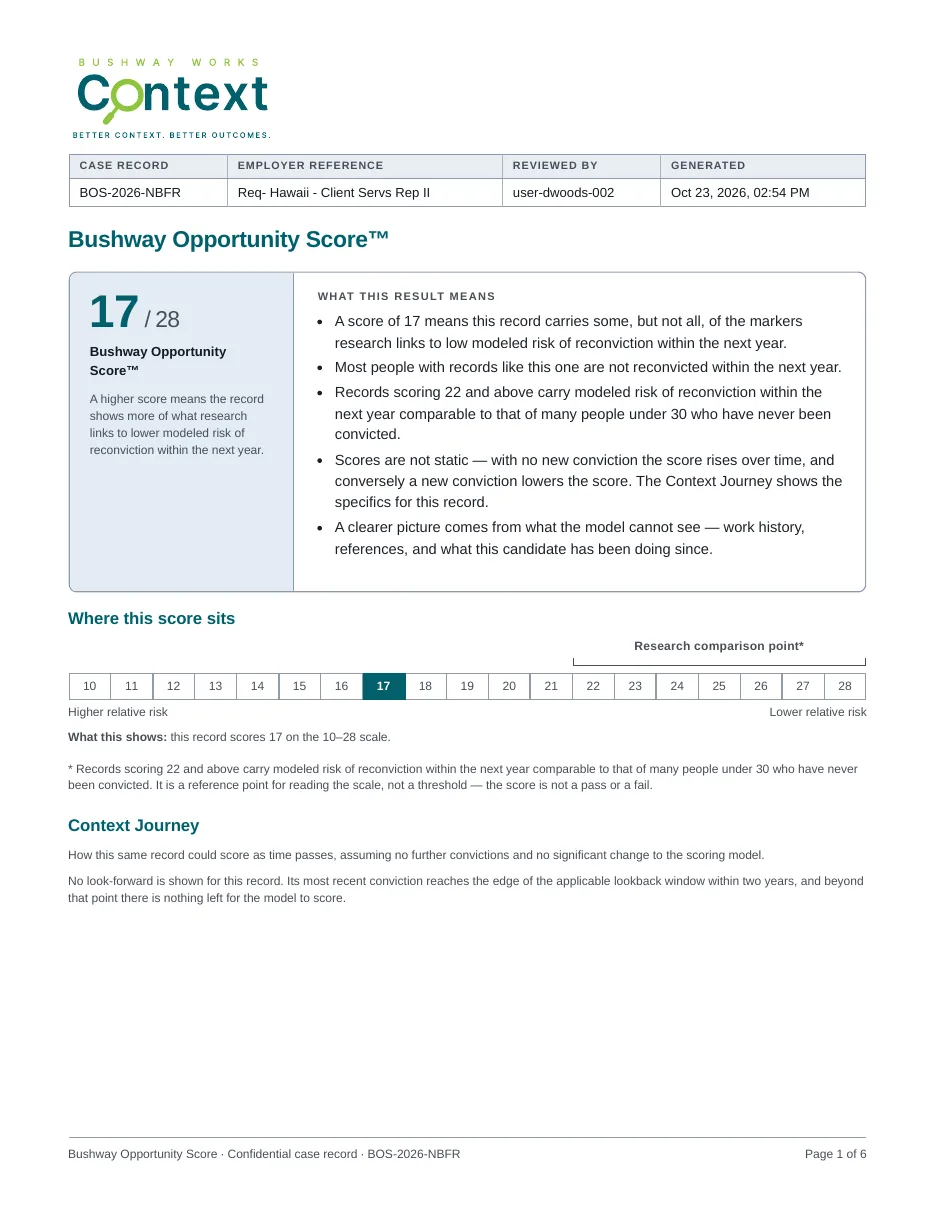
- Modeled risk of reconviction within the next year, estimated from the facts of a conviction record.
- Scale
- 10 to 28. A higher score means the record shows more of what the research links to lower modeled risk.
- Method
- A published statistical model (a survival model) developed by Dr. Shawn D. Bushway and colleagues. The score is not generated by AI.
- Thresholds
- Bushway Works does not publish or endorse any score threshold, cutoff, or pass/fail value.
The score is computed from facts of the record such as:
- Age at screening
- Age at first and at most recent conviction
- Time since the most recent conviction
- Number of felony and misdemeanor convictions
The charge itself is not an input. Neither is any demographic characteristic other than age.
What the score does, and does not, answer
- Gives a consistent, research-based measure of what the facts of a conviction record indicate about modeled reconviction risk.
- Reflects the passage of time: with no new conviction, the score moves toward a higher value as time passes.
- Comes with a plain-language explanation of the facts that produced it.
- Does not decide whether a particular offense is relevant to a particular job.
- Does not assess qualifications, character, rehabilitation evidence, or job-specific circumstances.
- Does not measure job performance or suitability for any role.
- Does not recommend a hire, a rejection, a threshold, or a legal outcome.
See it in action
The document your client would keep.
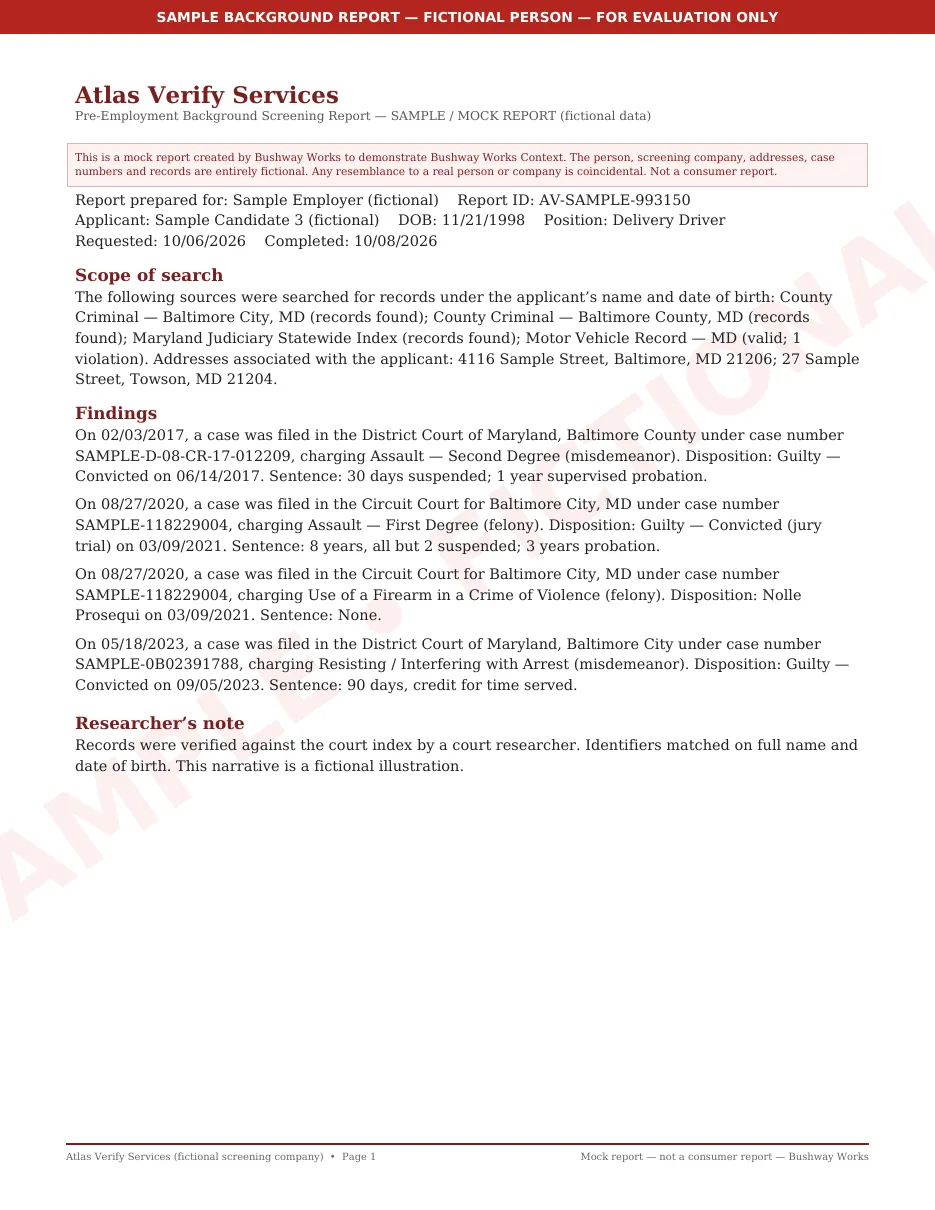
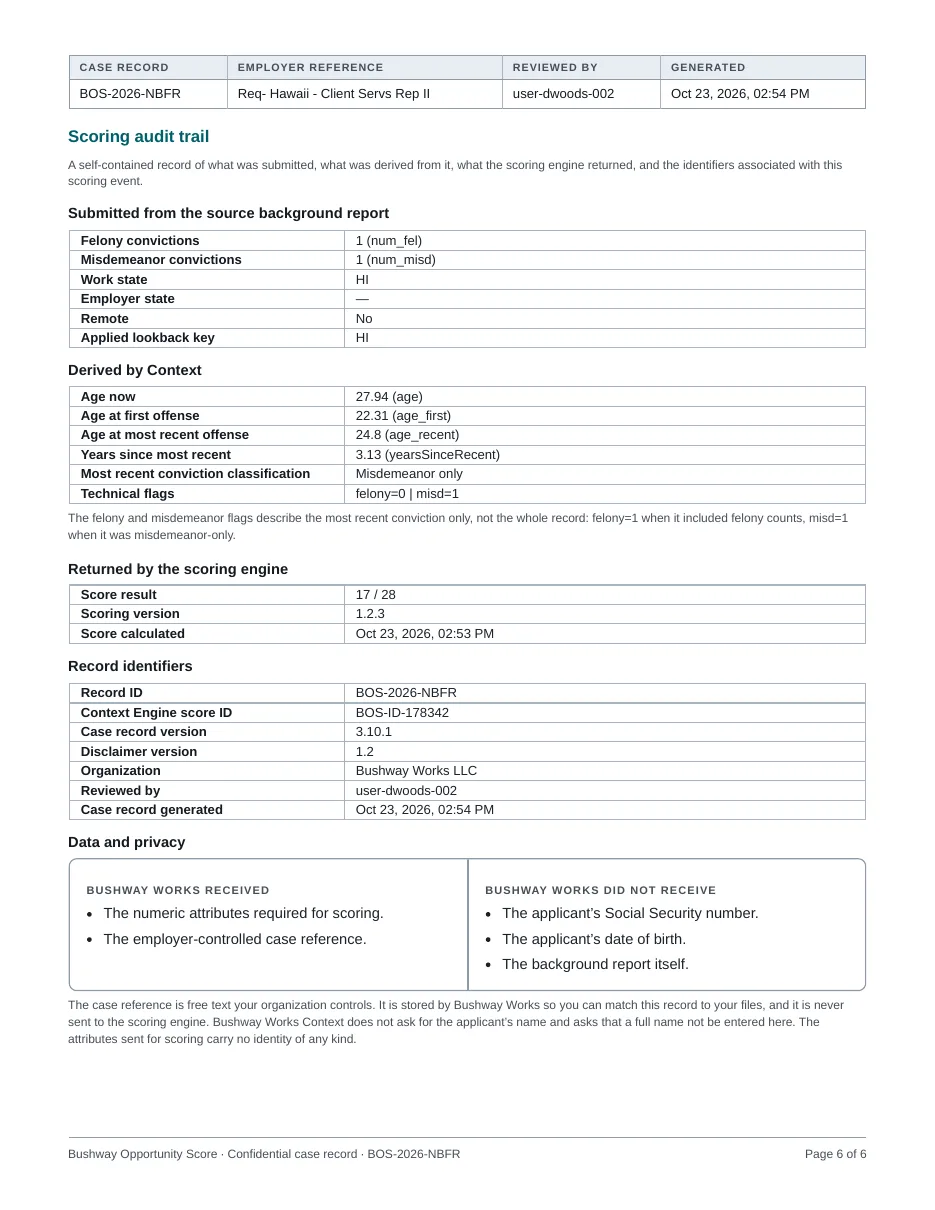
The case record states the score and what it means, the lookback rule applied for the job’s location, the limits of the model, and exactly what was entered and returned.
- Use restrictions and a 24-month reliance limit, written into every record
- Why the specific offense is not part of the score, in plain language
- A scoring audit trail: inputs, derived values, engine version, timestamps
- What Bushway Works received, and what it did not
Where the score fits
The score is one supporting input. It does not replace counsel, employer policy, or employer judgment, and it does not replace consideration of the nature and gravity of the conduct, the time elapsed, the nature of the job, or other information relevant under applicable law.
- 1Background report from the employer’s screening provider
- 2Employer policy and applicable legal screening rules
- 3Bushway Opportunity Score and its explanation
- 4Individualized review, including information from the candidate where applicable
- 5Employer decision and documentation
How the score is delivered
The Bushway Opportunity Score is the research-based score. Bushway Works Context is the Bushway Works software for obtaining it with an explanation and a documented review workflow.
Bushway Works Context
A browser-based workflow for teams that review cases themselves. Each case produces a dated case record with the score, the facts behind it, an explanation, and the reviewer’s attestation.
Integration
For larger employers, the goal is for the score to arrive alongside the background screen, inside the screening or adjudication system the team already uses. Feasibility, timing, and cost are evaluated with each employer and screening partner.
Scope, limits, and data
Who can be scored
The model is validated for people aged 18 to 60, for convictions within a 10-year window whose most recent conviction is at least one year old. Outside those limits no score is produced. That is a limit of the model, not a judgment about the person, and no inference should be drawn from the absence of a score.
Shorter lookback rules
Where a state or local rule sets a shorter window, convictions outside it are left out of the score entirely. Most such rules limit what a screening company may report; a few limit what an employer may consider. Context applies the stricter rule and records its citation and which kind of limit it is.
What is kept
Context keeps the facts of the record used for scoring, the score, and the case documentation. It does not keep the person’s name, date of birth, Social Security number, or the background report itself. A case is linked to a person only through the employer’s own reference.
Currency
The facts behind a score keep moving. A case record is dated, and a record more than 24 months old should be scored again rather than relied on.
Status
Research-informed decision support. Bushway Works Context is not a consumer reporting agency and does not make hiring decisions.
Counsel conversation guide
Five questions for opening a review of an employer’s criminal-history practices.
- 1
How does the policy address time?
Does the process distinguish recent records from older ones, and consider how time since the most recent conviction bears on the relevance of the record?
- 2
How is individualized information considered?
Where appropriate under governing law, how does the employer weigh job duties, the nature of the conduct, the candidate’s explanation, work history, and other relevant information?
- 3
Are reviewers using consistent inputs?
Do locations and business units apply shared guidance, or are materially similar cases treated differently without documented reasons?
- 4
Can existing systems accept added context?
Could the current screening provider or adjudication platform display a research-based score and its explanation without adding another review portal?
- 5
What is documented?
Can the organization reconstruct what information was considered, which policy was applied, and who made the final decision?
Where the score may be relevant
If a client wants standardized context about what the facts of a conviction record indicate about modeled reconviction risk, the Bushway Opportunity Score may be worth evaluating alongside existing policy and legal analysis. It is not designed to be an automatic approval or exclusion rule.
A practical introduction
“Bushway Works has developed a research-based score that may complement your existing criminal-history review. Would it help to look at how it works, and whether it could be delivered through your current workflow?”
Questions to consider before implementation
- Which decisions or review stages could benefit from an additional, standardized source of context?
- Can the employer’s existing screening provider or adjudication platform display the score and its explanation?
- How will reviewers be trained so the score is not treated as a cutoff or a hiring recommendation?
- Who assesses job-relatedness, applicable state and local restrictions, and FCRA-related obligations?
- How are exceptions, supporting materials, and decisions documented?
Research and legal references
Read the underlying sources, and confirm the current state of the law.
PEER-REVIEWED RESEARCH
- Chase, E., Bushway, S. D., Saunders-Medina, B., & Burgette, L. F. (2026). Safe to Hire: Predicting Recidivism Risk for Job Candidates with Criminal Records. Statistics and Public Policy.
The peer-reviewed methodology behind the score: a survival model built on criminal-justice records from seven states (CJARS, 1992–2021).
- Kurlychek, M. C., Brame, R., & Bushway, S. D. (2006). Scarlet Letters and Recidivism: Does an Old Criminal Record Predict Future Offending? Criminology & Public Policy, 5(3), 483–504.
Shows how the predictive value of an old record declines as time without a new offense grows.
- Kurlychek, M. C., Brame, R., & Bushway, S. D. (2007). Enduring Risk? Old Criminal Records and Predictions of Future Criminal Involvement. Crime & Delinquency, 53(1), 64–83.
Extends the 2006 findings on how long a past record remains informative.
- Blumstein, A., & Nakamura, K. (2009). Redemption in the Presence of Widespread Criminal Background Checks. Criminology, 47(2), 327–359.
Estimates the point at which a person with an old record presents risk comparable to the general population.
- RAND Corporation. Resetting the Record: The Facts on Hiring People with Criminal Histories.
A body of RAND research, grounded in Dr. Bushway’s work, on common assumptions about reoffending risk in hiring.
EMPLOYMENT-LAW FRAMEWORK
- Green v. Missouri Pacific Railroad Co., 549 F.2d 1158 (8th Cir. 1977).
The source of the three factors commonly used to frame criminal-record screening: the nature and gravity of the offense, the time elapsed, and the nature of the job.
- U.S. Equal Employment Opportunity Commission (2012). Enforcement Guidance No. 915.002, Consideration of Arrest and Conviction Records in Employment Decisions Under Title VII.
Discusses targeted screens built on the Green factors, and individualized assessment. It does not endorse or certify the Bushway Opportunity Score.
Status: in October 2026 the EEOC sent a draft final rule rescinding this guidance to the Office of Information and Regulatory Affairs for review. Confirm its current status before relying on it.
Methodology documentation
Counsel evaluating adoption can request the technical methodology, model coverage and exclusions, validation information, operational controls, and permitted-use documentation directly from Bushway Works.
For a methodology discussion or a joint client briefing
We are glad to walk counsel through the research, the model’s coverage and exclusions, and how the score could reach a client’s existing workflow.
Educational information only. These materials are not legal advice, not a legal compliance certification, and not a representation that any use of the Bushway Opportunity Score meets a particular legal requirement. Counsel and employers should evaluate applicable law and intended use independently.